One Funeral, Two Lessons

13 Aug

I recently attended the funeral of a young man whose family we’ve known for three decades. He was killed in an accident, his life of twenty-one years cut far too short.

Ever since Brandon was young, he knew he wanted to be a chef. He loved food, loved being around the world of hospitality, and pursued the craft with great passion. In fact, he was just about to complete his training at a culinary school of some repute, and had already gotten hired by a fine local restaurant.

Among those attending his funeral were his fellow students. And they showed up dressed as he would have dressed– in their white, cleanly pressed chef smocks. They came. And when the funeral was done and it was time to share a meal, his fellow students were there to serve. To provide a repast. To bring nourishment. To offer, on a garnished plate, the love that Brandon so passionately pursued. One of his fellow students remarked about the impact Brandon had on him:

Upon graduation you are given a sash consisting of cheesecloth, butchers twine, a tasting spoon and a sprig of sage.  Each representing something different but overall symbolizing a milestone, where you leave one place and begin a life in another.  Prior to graduation you must complete a number of classes, one where you must cook a four-course menu for 8 guests in 30 minutes.  By yourself it is very tough, but with help, good help, it becomes much easier.  I called Brandon asking if he could help, and without pause he said yes.  Today at the cemetary I placed the sash given to me with Brandon; it is because of his selfless help that I was able to graduate.  My thoughts and prayers are with your family Brandon, and watch over me when I need help, though I know you will already be there.

The loss of this delightful young man is certainly a tragedy. But another tragedy is the number of people who go to work each day absent the passion and zeal Brandon had for his profession. For him, vocation and avocation were one. I see so many people who don’t feel that sense of passion and joy for what they do. To them, work is a “chore”, something to done only for as short a time as possible so they can then turn to what they view as more enjoyable, meaningful pursuits.

It doesn’t have to be that way.

Brandon was a chef. That was in his heart. It was what he felt called to be. There are others, perhaps you, who would find working on your feet in a hot kitchen trying to serve a demanding, finicky public the furthest from your career dreams. That’s fine. Find the work that does call to you, that get’s you thinking every day “I’m a very lucky person to go to this company doing the kind of work I do.”

This is not, by the way, a pipe dream that came only to Brandon. There are many people who have found the work that fits them, work for which to them time seems to fly by, work where they easily grow and adapt to changing conditions, work where others seek them out as a mentor. The best companies we’ve studied in our ongoing research help employees on this journey, one that is good for everyone.

It’s out there.

The other lesson from this day, which several of us who were in attendance noted, was that “life really is short, don’t waste it”. Indeed, life is too short, and I suspect there are many out there who are wasting the precious time they have stuck in a job that, quite literally, cuts the life out of them.

I’m a fan of the movie About Schmidt, filmed here in my hometown of Omaha, Nebraska. The title character, played deftly by Jack Nicholson, is the kind of person I’m talking about– he hated what he did, was loathed by those with whom he worked, and quickly forgotten once he retired. Toward the end of the movie Schmidt laments:

I know we’re all pretty small in the big scheme of things, and I suppose the most you can hope for is to make some kind of difference, but what kind of difference have I made? What in the world is better because of me?”

In his twenty-one years, Brandon made a great difference in the lives of many, in part because of his passion, his zeal, his love for his craft. Because Brandon loved his work, his life mattered even more. Don’t let your life end up as scraps on the butcher’s block– make your life into a four-course, gourmet meal.

Those are “Top-Chef-four-star-Zagat-approved” lessons. Take them.

“I’m Not Good at Cutting”: A Lesson about Talents

2 Aug

The pre-school teacher had a goal that day– to have each student draw a character on construction paper, cut it out, and finish it so it could go home that afternoon with each child. On face value that seems like an innocent enough task that should be easily accomplished by each kid, right?

For our daughter Jill, it wasn’t quite so easy.

Jill is twenty-one now, will soon start her senior year at the University of Nebraska, and is considering options for graduate school. She is a delightful person with a great passion for life and promising career. But on this fateful day some seventeen years ago Jill ran into a teacher who was more interested in seeing her agenda accomplished than helping our daughter discover and develop her talents.

Jill is a meticulous person. She likes to have things “just so”, and when working on a task she deems important will take the necessary time to perform it to her exacting standards. She’s that way now, and was that way seventeen years ago. So when it came time for her to color and cut out the character at pre-school she was doing the job with the kind of attention that is part of her DNA, her basic character.

Some teachers might note her approach and even encourage the development of that behavior. But on this day, in the eyes of this so-called teacher, Jill was lagging behind the rest of the kids. She was not keeping up with the class and was in danger of not having her character cut out by the end of the day to take home. So as the school day neared its end and Jill wasn’t done what did the teacher do? She finished cutting the character out herself. Because Jill was careful, but slow, the task was taken away from her.

She came home that day in tears. Asked why she was crying, she said: “Mom, I’m not a good cutter.”

That’s what the teacher told her. I’m not kidding.

Why am I telling you a story from seventeen years ago about cutting figures out of construction paper? Because every day there are employees who are suffering the same fate, the fate of a workplace that doesn’t recognize their talents and tries to arrange the workplace to best nurture them.  Employees who should be using and developing their talents are doing work in conditions that don’t suit them, and because they are “slow cutters”—doing work that is not a good fit for them– their productivity and the productivity of their employer suffers.

Think about Jill for a moment. She was “slow” when it came to cutting, but look at the other side of equation. Do you know of work where attention to detail is important, where being meticulous is a valued asset? I can think of many companies who pay big bucks for people who have that kind of personality, who love doing detail-oriented work, who don’t seem to tire of it and look forward to the next time they get to use that talent. I can think of a gaggle of such jobs.

In fact, Jill holds one of those jobs right now. She works for a group home for adults with developmental disabilities. Most of the residents have needs that require numerous medicines be distributed accurately and on time. The supervisor of the home actually changed the schedule, including volunteering for part of a shift himself, so that Jill could perform the weekly medicine review as drugs were shipped to the home from the pharmacy. You see, Jill has a talent that is of significant value to her employer and the clients she serves. She may “cut slow”, but her boss doesn’t care about that. He cares about making sure that the correct medicines are administered at the right time at the right dosage to the vulnerable clients the agency has been entrusted to serve. Kudos to her boss for recognizing and utilizing that talent.

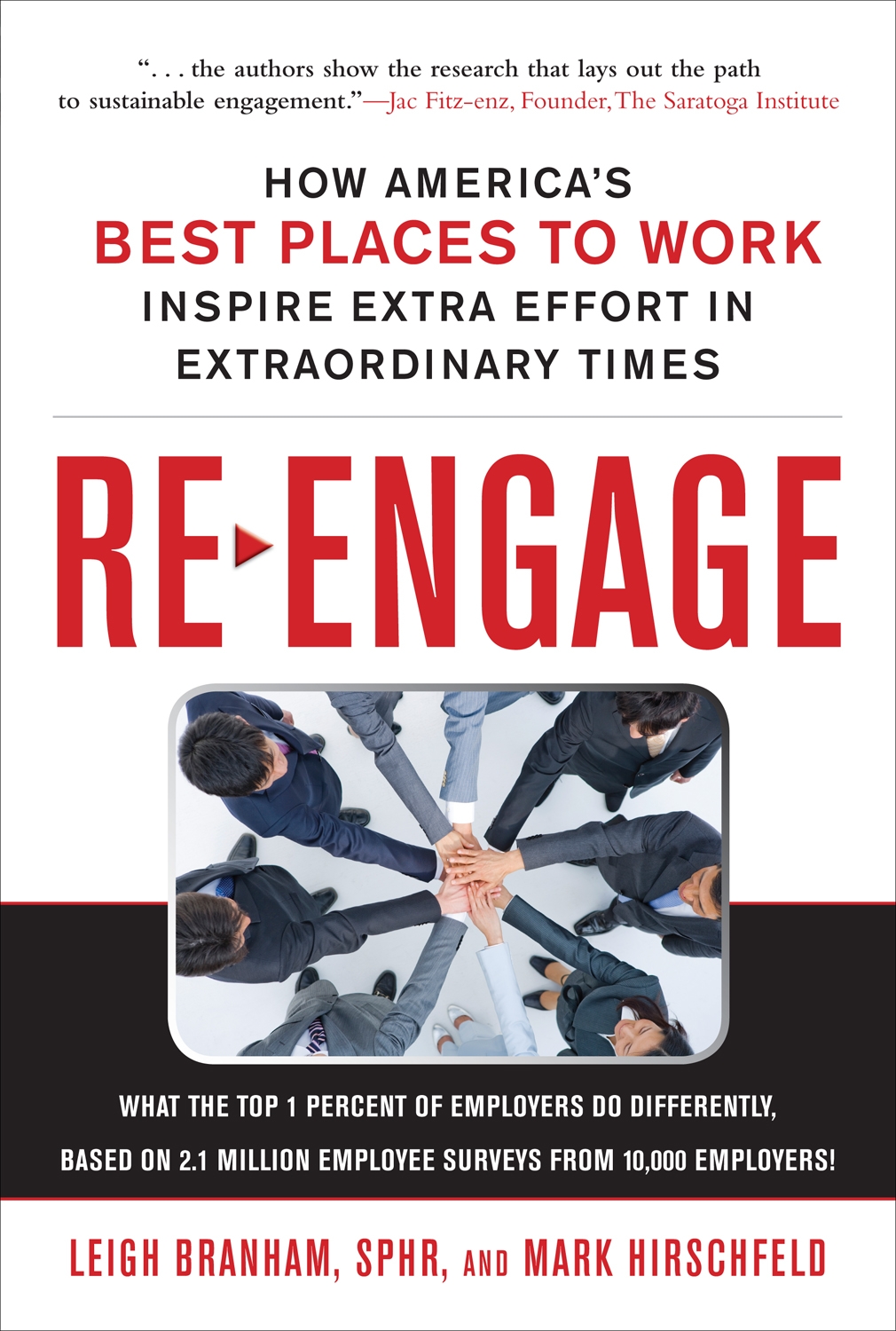
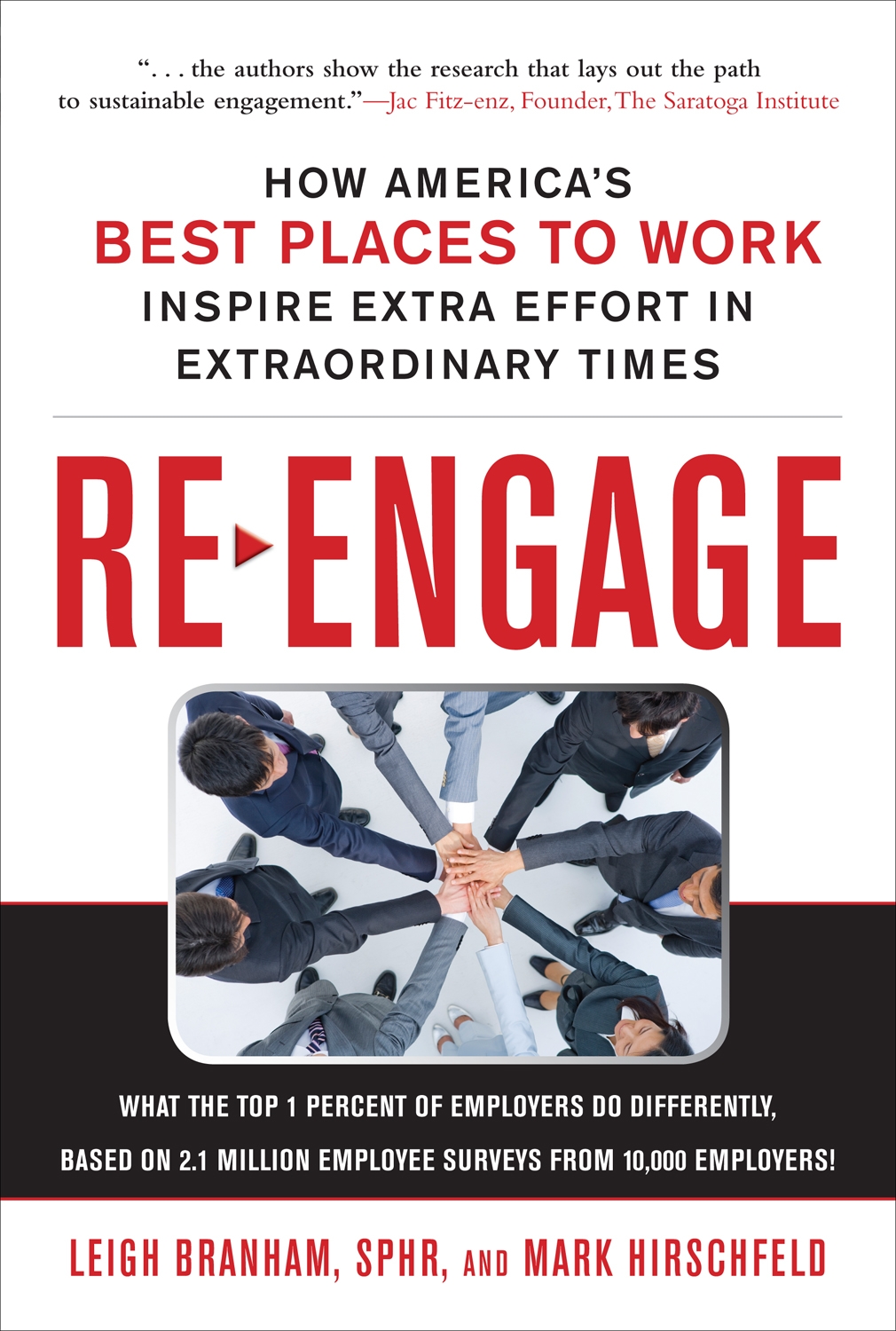
The companies we profile in Re-Engage do a far better job of helping their employees find roles that fit their strengths and where they see opportunities to grow and develop. It is one of the six universal drivers our research says contributes to highly engaged workplaces. One employee at a winning Best-Places-to-Work said:

“This is a great place to work, a place where an individual can utilize their talents and move freely amongst department to pursue their work interests and passions.”

Let’s help each and every employee with whom we work utilize their talents. Let’s get the meticulous folks doing jobs that fit them, the more creative folks doing creative stuff, and if you need a cutting job done quickly I’m sure there are people who are exceptional at that too.

Want to re-engage your staff? Stop ignoring their talents and start putting them to work.

Re-Engage A Top Seller At SHRM Conference!

14 Jul

We just received an email today indicating that Re-Engage was one of the top-selling books at the global SHRM conference just held in San Diego.

Our thanks to all of you who supported the book and attended our session. We enjoyed the time, and look forward to continuing our discussions!

(There are many places to purchase the book, including at the  SHRM web site: http://www.shrm.org/Publications/Books/Pages/default.aspx)

If you don’t like sheep poop…

12 Jul

At church this past Sunday our senior pastor, George Moore, gave a sermon about being a good shepherd. His messages are always terrific, but his words about being an effective shepherd (leader) really struck me.

We know the tasks of the shepherd– at church, home or work– are not always easy. A shepherd’s sheep often need help, need care, need support,  and need love. And George sees some people who have taken up this role as less than enthusiastic about many of those duties. In fact, he noted that there are some in shepherding roles today who don’t seem to even like sheep. He has some pretty blunt advice for them:

If you don’t like sheep poop, don’t become a shepherd!

In writing Re-Engage we ran into far too many employees who don’t feel like they have very good shepherds. They are often discounted, lied to, ignored, kept in the dark and often discarded on a whim. Here’s how one employee described her leader:

This organization views employees as fiscal liabilities to be limited as much as possible; until we are perceived as assets rather than liabilities, it will never be a great place to work.

There are, sadly, too many leaders who act as if they don’t really like working with employees. They don’t want to deal with employees who have wants, who have desires, or who have needs, because in their mind all that employee stuff can sometimes get, well, messy!

But here’s the part that poor shepherds don’t understand: not caring for and engaging employees saps their energy, splinters their morale, and eventually drives them away. Employees are hungry for great leadership, and when they experience it they will take longer commutes or less pay or turn down promotions to be part of a group that is shepherded well. Here’s an employee at a different company talk about the leadership where he works:

This company is a great place to work. If I have a problem, I feel confident going directly to one of the managing partners because I know they truly care. They know who I am and are always willing to help in any way.

It’s true, employee engagement can get messy. Here are a few of the additional “chores” our research indicates drives employee engagement:

  • Employees value more open and honest communication than every before.
  • They want leaders who have an idea of where to lead them, yet are open to feedback that might help make a needed course adjustment.
  • They’re hungry for opportunities to learn and grow in ways that use their talents to advance the interests of the enterprise.
  • They demand being part of a team that understands what they’re doing and leverages the respective strengths of each team member to put together a work product for which the team can be proud.
  • And when they succeed in adding true value to the organization they want to be recognized and rewarded, including a fair wage and benefits that meet their needs and the needs of their family.

Chores indeed. But according to every bit of research we’ve seen (and what my gut says anyway), investing in the engagement of employees, particularly in these difficult times, can make all the difference.

Thank you, George, for reminding me that shepherding can often be a challenging business, one that requires a little time and a bit of elbow grease applied in the right measure.  But I’m convinced the good shepherd will be rewarded.

There’s Something Contagious About Engaged Employees

8 Jul

At the 2010 SHRM conference just held in San Diego I had the opportunity to experience a seemingly small but fundamentally profound impact of having a group of highly engaged employees– loyal customers. Here’s the story:

In the course of presenting on employee engagement at the conference I mentioned the efforts of Rackspace, a web hosting company located in San Antonio, Texas. Rackspace is one of seven companies featured in Re-Engage that have been identified as one of the great American workplaces by our research partners Quantum Workplace. In my remarks I mentioned the “fanatical support” provided by employees, who are affectionately called “rackers”. Rackers are encouraged and supported to provide service above and beyond anyone in their industry, an asset company leadership believes is the most important asset in helping them become the largest player in their field.

After the speech a woman introduced herself and shared the following:

Mark, I enjoyed your speech, and was delighted that you shared a story about Rackspace. We have been a customer of theirs for some time now. Our IT manager loves the service they offer and tells me he would never consider moving the business to a competitor. The other important thing you need to know is the Rackspace approach to fanatical service has rubbed off on our IT staff. It’s kind of like paying it forward.”

Remarkable!

The outstanding service provided by engaged employees at Rackspace has, like a contagious virus, made its way into the workplace of this customer. In the spirit of the movie the IT manager is “paying it forward” by spreading the enthusiasm, care and support to those whom he serves.

One of the great joys in writing Re-Engage was the opportunity to study companies across the United States that have proven themselves to be great places to work. We talk about the “link” between employee and engagement and key business outcomes– such as more loyal customers– but those studies can often seem impersonal and sterile. But when you hear a first-person story like this, you know there’s an immutable truth about the impact of an engaged workforce that cannot be denied.

Want more loyal customers who sing your praises and are grateful for the service you provide? Engage, and re-engage, your employees.

Take Care of Employees and They’ll Take Care of Business

1 Jul

I love attending the local Best Places to Work events where companies are recognized for their efforts to create engaging work environments. They are celebrations of workplaces that have created the conditions where people choose to work hard, care deeply about their associates and customers, and employees have a commitment to stay and grow with their employer.

At one such event Microsoft was recognized as a Best Place to Work. They frequently appear on these local lists, and have often been tapped in the annual list published by Fortune magazine. As part of the description of why Microsoft made this local list it was noted that they were one of the first U.S. employers to offer a benefit where employees who have children diagnosed on the autism spectrum can receive early intervention therapy services to support their development.

Let me go on record here-I have a child with autism, and am very familiar with these services. Although they are widely recognized as helpful to children who suffer from autism (including an endorsement from the Surgeon General) they are not typically paid for by private insurance. Most families, including ours, pay for these services out-of-pocket. Having an employer like Microsoft fund these therapeutic services through their health insurance program is a tremendous benefit to families who have a child with this condition. (An article in the Seattle Business Journal offers more details about the benefit.)

I tip my hat to Microsoft for the efforts to help families like mine (and I hope you consider advocating for such a benefit where you work), but the other part of the story is this: Microsoft is listening to the needs of their employees and offering benefits to address those needs. They received numerous requests from employees, who told the company their stories and made their cases for why this would be an important benefit. And to their credit, the company responded.

In our research into the elements that drive highly engaged workplaces we note that an employer’s ability to support the well being of their employees is a key driver. It’s also one that has increased in importance over the last five years. We speak at length about this in chapter nine of our new book, Re-Engage as well as an article in the May, 2010 issue of workspan. Employees who believe their companies genuinely care about them and their families are more likely to be engaged, productive employees. In this case Microsoft saw value in funding autism services. For another company it might be a wellness benefit. In yet another company the employees may find additional support for continuing education to be of value.

What’s clear is this-employees will care more about work when they believe their employers cares about them.

Cowboys and Horsebits: A Lesson In Talent Management

15 Jun

In the early 1970’s my father hired Bev to join the sales team at our family clothing store in North Platte, a small town in west-central Nebraska. She took quickly to the job, learning the intricacies of selling everything from tailored Austin Reed suits to Nunn-Bush shoes. It became clear Bev had the ability to build good relationships with customers, get them to leave with a sack in their hands, come back often and talk up the store as the only place to shop-the outcomes every retailer craves.

To my father’s credit, he saw beyond Bev’s talent in sales. He learned that when she wasn’t working at the store she was often doing “cowgirl” stuff-riding horses and attending rodeos. As my dad got to know her a question came to mind-could he combine her interest in “western” activities with her gifts in retail?

The answer was a new store that sprouted across the street called “Circle A Ranchwear”, to which Bev was appointed the new manager. Because of her passion for the western lifestyle and talent in sales she quickly attracted customers to the new business, selling cowboy boots, western-wear clothing items, even specialized horse tackle.

For me, it’s a terrific example of getting people into roles where their talents, skills and interests can be best used in the workplace. From the 100,000+ survey comments we have read in the last few years, here are three from individuals who have clearly benefitted from their employer’s efforts to match their talents with the work at hand:

“This a great place to work, a place where an individual can utilize their talents and move freely amongst department to pursue their work interests and passions.”

“Our company really plays to the strengths of its employees; it rarely assigns someone to a task to which they are not suited. Once an employee shows their talent, they can be moved from day-to-day operations to development, or if an employee is showing signs of burn-out, a departmental move is soon to come.”

“Recently, my team was assigned their own set of clients to handle independently. From my perspective, it demonstrates the firm’s interest is recognizing and challenging each person’s ability and talent recognizing strengths and weaknesses.”

Can you imagine how much more productive organizations would be if more of their employees felt like this? Work then becomes a place where a person has the opportunity to utilize the best of who they are and, in doing so, help their employer succeed.

In the case of Bev, her reputation for outfitting cowboys and horses spread. One day she received a telephone call from a man from Utah who was looking for a specialized horse bit. He had been calling all over the United States, and numerous inquiries had finally led him to Bev. To his delight, she had the item in stock and was happy to help. The man sent her a check. Rather than cashing it, my dad decided to frame it. After all, it’s not every day a little store in the outback of Nebraska does business with the actor Robert Redford!

Whether it is casting a feature film or retail store, getting the right people in the right place can make all the difference.

Photo uploaded on Flickr by Alana Holmberg

Man’s Best Friend… Dog or Manager?

9 Jun

It’s been said that a dog is a man’s best friend, but this employee believes his supervisor isn’t a friend to man or beast:

“If my manager treated a dog the way he treats my teammates and me, he would get sued for cruelty.”

This employee works for a company whose overall employee engagement scores (as measured by the survey conducted by Quantum Workplace) is far from acceptable, and the company is suffering as a result. We are simply befuddled how companies continue to tolerate managers whose treatment of employees makes them feel this way. Unfortunately, many of us have had personal experience working for such managers. In fact, a recent Gallup survey reported that more than half of all U.S. workers would fire their bosses if they could.

The penalty employers pay for bad managers is poor customer care and loyalty, to which numerous studies clearly point. Among the verbatim comments in Quantum’s Best-Places-to-Work surveys we came across this nurse’s lament about how the “disease-ridden” culture at the hospital where she works is negatively affecting patient care:

“I have been a nurse for over 20 years and this is by far the worst hospital I have ever worked in.  Management does not treat employees with respect, nor do employees feel as if they are valued members of a team.  Managers are also unprofessional and condescending.  In addition, patient safety is often compromised and nothing is done to rectify the problems.”

Anyone interested in being admitted to that hospital? The same dynamic happens in every industry-disengaged employees simply don’t take care of customers the way engaged employees do, and the business suffers as a result.

Thankfully, supervisors don’t have to act in ways that create these feelings. For employees to be productive, they cannot be treated like yesterday’s garbage. If treated with respect, care, and consideration, most employees will respond in kind and offer even greater effort in their work and service to customers. Here’s a comment from another employee who works for a company recognized as a “Best Places to Work”, and talks quite differently about the relationship he has with his supervisor:

“My manager is really aware of our work load, and how difficult our work is. He is always there if we have a problem, and always willing to look at our work and help us figure out how to solve the problem. He really values our work, and makes sure that we know it.”

Wouldn’t you rather work for this manager? This kind of manager engenders loyalty and effort, which is even more important in these more challenging economic times. This is the kind of manager that employees point to and say, “There’s the one you want to work for.”

In writing Re-Engage we wanted to contrast the difference between effective and lousy managers. For those who make their employees feel like they’re being treated like rabid animals, maybe we should set up a companion organization to the American Society for the Prevention of Cruelty to Animals, in this case the “Society for the Prevention of Cruelty to Humans”, where we could turn these disengaging supervisors in for citation and reassignment into a job where they can do no more harm. On a more serious note, we recommend reading Temple Grandin’s book Animals Make Us Human, in which we she reminds us that all animals, human and otherwise, have feelings that can be positively or negatively engaged, and respond very well to praise.

Photo originally uploaded on Flickr by Dan65

John Wooden, Thank You

5 Jun

Originally uploaded by ETSU Photos

John Wooden, a remarkable coach and even better man, died yesterday.

Nancy and I had the great pleasure of meeting him many years ago when he came to Lincoln, Nebraska. What immediately struck me, and sticks with me today, is what a gracious, humble man he was. He certainly had much to crow about (ten national basketball championships and winning streaks that will unlikely be matched), but to his core he stayed true to his values.

In his speech to talked about his famous “pyramid”. It is his guide to living an honorable, productive, meaningful life. If you’ve not read his memoir “They Call Me Coach”, which includes his discussion of the pyramid, I certainly recommend it. It’s an easy read into the mind of a great leader, worth it even if you’re not a big basketball fan.

Wooden was a quote and quip machine. If you Google him you can find a bunch. Here are some of my favorites:

Winning takes talent, to repeat takes character.

You can’t let praise or criticism get to you. It’s a weakness to get caught up in either one.

You can’t live a perfect day without doing something for someone who will never be able to repay you.

The main ingredient of stardom is the rest of the team.

Talent is God given. Be humble. Fame is man-given. Be grateful. Conceit is self-given. Be careful.

Success is never final, failure is never fatal. It’s courage that counts.

Never mistake activity for achievement.

If you don’t have time to do it right, when will you have time to do it over?

Do not let what you cannot do interfere with what you can do.

Adversity is the state in which man mostly easily becomes acquainted with himself, being especially free of admirers then.

Peter Drucker once said that leadership is defined “by the presence of willing followers”. If that’s true (and I believe it is) John Wooden has to be defined as a great leader. To hear his former players such Bill Walton or Kareen Abdul Jabbar talk about him is inspiring. What’s so striking is the players talk much less about what Wooden taught them about the game of basketball, which given that he taught some of the game’s best players was significant. But to them his impact on their lives was much more about how to live off the basketball court. John Wooden taught them first to be good men who then became good basketball players.

Lest we think him a saint, he had his faults. He was occasionally mean-spirited, to the point of abusive, to opposing players. I credit him for identifying this fault and owning up to it in later years.

Great leaders should take a number of pages from his playbook:

  • He invested in knowing his players. He was involved in their personal lives. He truly cared, cared deeply, about them.
  • He built his teams around the talents of his players. He wasn’t afraid of changing the plays to fit the strengths of who was on his team at the time.
  • He showed them to be fierce competitors who were humble winners and gracious losers.
  • He held them to a strict set of rules when it came to manners and appearance and comportment.
  • He never pushed his personal faith on others, but was an example to them of what his faith called him to be.
  • He prepared them to be successful not just in their sport but for the rest of their lives.

Thank you, Coach Wooden. You have touched so many.

The Magic Elixir of Innovation

2 Jun

New products and services are coming into the market in an increasingly faster rate. In every business segment companies must find ways to provide new, innovative approaches to meet the needs of a demanding customer base.

We often think of innovation as something done in a laboratory, where scientists toil to create a new and better widget, or perhaps a new elixir to cure all that ails us. This kind of innovation is certainly important, but is the “mad scientist” laboratory the only source of innovation?

In the course of studying companies that have been consistently seen as “Best-Places-to-Work” we’ve found another way to foster innovation: create a highly engaged workplace. In these environments much innovation comes from everyday workers who see an opportunity to do something better, to serve a customer more effectively, or to streamline a clunky process. In poring over comments of both high and low-scoring companies in the thousands of employee engagement surveys we analyzed, we came across several that reveal   how companies have built cultures that  support innovation. The first comment speaks about how the company has encouraged employees to offer their own ideas:

“Innovation is openly appreciated and genuinely valued; any individual in the company may provide their own ideas and, if viable, they are truly leveraged.”

Innovation can’t happen when employees don’t feel empowered. One employee remarks:

“I believe that allowing employees the freedom to manage their lives and work on their own time is the most important part of creating a productive environment. Also, giving everyone the freedom to express their opinions about company decisions gives us all a feeling of ownership and pride, and helps perpetuate constant innovation that makes everyone feel as if we are always moving forward.”

The following comment is from an employee who sees transparency in communication as a factor that supports the culture:

“They set the stage for innovation and welcome progressive thinking. They think outside the box and welcome new ideas.  They also have regular updates on new business and the current environment and give us the information that we need to know–that things are tough out there, but they have a commitment to the people that are working here now.    They have launched a program for employees to give new ideas to senior management directly.”

Finally, one employee reveals how customers react:

“It is a pleasure to be with a company so driven by innovation.  I leave meetings with clients and they are blown away with our capabilities that we have introduced to them.  I report to smart, warm professionals who are well respected.  Nice work if you can get it.”

Indeed, nice work if you can get it. Sadly, many employers have not created the kind of engaging cultures these employees have described. They work in environments where creativity is, even unwittingly, drown out.

“There is a very negative atmosphere in my department and the managers are not responding to employee feedback. Employees do not feel valued or appreciated. They are overworked and underpaid and feel they have no say in how to make improvements within the department. Numerous people have gone to HR and top leadership, but there have not been any positive changes.”

Can you imagine anything innovative coming out of this work group? Not likely. Or this workplace:

“Our services and support departments tend to be major speed bumps to innovation and general ‘getting-s&!t-done-ingness’.  If the resources are stretched as thin as we hear whenever a new feature or old bug is brought up, that needs to be where we’re focusing our spending.”

We’re not suggesting that innovative ideas can’t come from workplaces that are disengaged. They do. But we can’t imagine creative ideas flow as frequently and consistently in an environment where an employee is worried about, and we’re quoting here, “getting-s&!t-done-ingness”. We’ll give the edge to the workplaces that encourage open and honest communication, actively ask for a receive feedback from all employees, and create environments where good ideas are rewarded with other opportunities. That’s an elixir that will bring results.

Want to be more innovative? Engage, and re-engage, your employees.

We invite your comments!

(Photo from Flickr by bframe5)