
Archive | Employee Engagement RSS feed for this section

A New Low

7 Jan

The Conference Board has released a new study, which I picked up via National Public Radio, that employee satisfaction (as the Board measures it) is at an all-time low. They report that “just 45 percent of people surveyed said they were satisfied with their jobs. That number fell from more than 61 percent who said they were satisfied in 1987, the first year the survey was conducted.”

Yikes.

The report continues:

Even more troubling, says Lynn Franco, Conference Board spokeswoman, is the satisfaction rate of young workers, less than 36 percent.”Generally the longer you are in the workforce the more your satisfaction seems to deteriorate. So these new young entrants with such a low level of satisfaction, the outlook is not very promising there. It’s something employers need to address very quickly.”

These findings are generally in keeping with the survey results we see from our partners at Quantum Workplace. How many companies have reacted to the economic conditions and their approach to leading their employees through this mess has not helped the cause– we’ve generally blown it when it comes to maintaining and highly engaged place to work.

For some managers the response will be a shrug and feeling that nothing can be done. For others this can be a rallying cry in to increase efforts at re-engaging those with whom they work. (“re-engage”, kind of a catchy name!). Here’s hoping you are one who is ready to lift up employees and renew engagement at work.
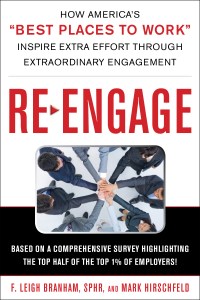
Book Release February 12th

5 Jan

RE-ENGAGE

I’m pleased to announce that our book, Re-Engage, will be available February 12, 2010. My thanks to co-author and good friend Leigh Branham for making this one of the most exciting projects of my professional career!

Until then, I’ll be using this blog as a place to post the results of our continuing research into the elements of great workplaces.

You can also keep up with our musings on Twitter: @ReEngageBook

Some Workplaces Healthier Than Others

30 Oct

aerobics

According to a study publishes by CNN some workplaces are definitely not good for your health! Thankfully, some are actually quite healthy. The study cites several factors that differentiate betweeen the two cohorts. The research for our book reaches similar conclusions. I’m convinced we can help our employees become healthier and more productive using these guidlines:

Not all workplaces are created equal when it comes to health. In fact, 38 percent of workers at certain jobs — called “effective” workplaces in the report — were much more likely to say they were in excellent health. Conversely, only 19 percent of employees in workplaces with a low effectiveness rating reported being in excellent health.

So what makes an effective workplace? Six factors make a difference, Galinsky says. Workers may feel healthier if they have “learning opportunities and challenge, a good fit between work and personal life, autonomy, having a supervisor who supports job success, economic security — no surprise in this economy — and a work climate of respect and trust,” she says.

Wellness and Employee Engagement, Again

26 Oct

treadmill

A good post in the Montreal Gazette profiles two employers that have done an outstanding job creating a highly engaged place to work. Part of their strategy is helping employers through wellness. Here’s how one of the companies sees wellness and engagement:

Pfizer recently received the highest possible accreditation by Quebec’s Bureau de Normalization as a “healthy enterprise” for its Viva program.

Viva, says St-Pierre, is an employee wellness program based on prevention, awareness and employee support.

“It promotes healthy lifestyle habits through a three-pronged approach: physical activity, nutrition and work-life balance. Employees have access to coaching by health-care professionals, such as a kinesiologist or a dietitian and we have health fairs and workshops.”

In addition, there is an on-site gym, flexible work arrangements that feature Friday afternoons off and the Viva internal website that offers wellness information.

Congratulations to yet another employer who sees the value of wellness in helping employees achieve a healthier lifestyle and, in doing so, create a more productive, engaging place to work.

Good and Bad Ways to Retain Employees

3 Sep

Cute video scenes on good and bad ways to retain employees. The “bad” are supposed to be spoofs, but sadly they are more real than we would like to admit.

What’s A Racker? The Rackspace Story

27 Aug

One of the companies that we feature in our book Engage! is Rackspace of San Antonio, Texas. Their employees, lovingly called “rackers”, are truly an engaged group! The Rackspace culture has helped them become one of the fastest growing, successful firms we’ve had the pleasure of studying. Here’s a video of rackers talking about Rackspace.

Can Changes In Employee Engagement Fortell Movement In The Economy?

24 Aug

tarski-720x180

My friends at Quantum Workplace think there’s substance to this question. At their The Science of Work blog earlier this month we find their most recent post on the topic:

Our June 30 blog post predicted July would be an “up” month for the Dow Jones Industrial Average. And “up” was an understatement as we saw the stock index climb 8.6% in a single month. That improves the record of our linkage analysis between our Employee Engagement Index and the Dow–successfully predicting movements in 12 of the last 15 months.

Unfortunately our Engagement Index showed a slight decline between April and March. Due to the 4-month lag in our model, we’re expecting a corresponding decline in the Dow for August.

CNBC, are you listening?

The theory behind this is interesting– if we’re more engaged as a country, for example, and four months later our “extra effort” shows up in improved company performane as measured by movement in the Dow Jones.

We know there is a relationship between employee engagment and business performance at an individual company level– could it translate on a “macro” level?

Stay tuned!

Yet Another Study Linking Engagement & Patient Satisfaction

21 Aug

20090618-healthcare

Yet another study reported by PR Newswire of the relationship between employee engagement and patient satisfaction:

“In the health care industry, as in other service-related businesses, having engaged, empowered, loyal employees can lead to increased retention, lower costs, enhanced reputation, and a profitable business picture,” said Forum President Michelle M. Smith, CPIM, CRP, vice president, business development, O.C. Tanner Company. “And now, we are finding that having satisfied employees leads to higher quality of patient care and overall better patient experiences.”

Some key findings from the study, found at www.performanceforum.org, include:

  • Patients that have higher levels of satisfaction are most likely to recommend the hospital to others when they are treated by highly-satisfied employees. Word of mouth, more than any other source of marketing promotion, is a primary driver in patient care decisions.
  • As the popularity of electronic testing and monitoring expands, health care employees, more than ever, need to exercise “the personal touch” in caring for patients.
  • In addition to what health care workers do, emphasis needs to be placed on how employees feel about what they do. Patient experiences will not be good if employees are not happy.

It’s beyond my pay grade to sort out all the reform that we need in our health care system, but it’s above anybody’s pay grade to see the evidence that more engaged employees is one key factor to the success of our health care delivery model– more engaged employees leads to more satisfied, healthy patients.

Case closed.

Good Bosses Gain Employee Loyalty

20 Aug

2548782366_795782ee45

This Associated Press article features Leigh Branham, my co-author, talking about the importance of employee retention for small businesses:

Many employees of small businesses are grateful to have a job, even as salaries are frozen or cut and they’re asked to take on more responsibility. Company owners shouldn’t take those good attitudes for granted — they need to show workers some loyalty so staffers don’t jump ship when the economy gets stronger.

“This is a crucial time,” said Leigh Branham, owner of Keeping The People, a human resources consulting firm in Overland Park, Kan. “Employees are testing you to see how loyal you are to them, to decide if they’re going to stay.”

The article presents several excellent ideas for keeping employees in these more difficult times.

Hopefully, you’ll read the article, manage accordingly, and “pass the test”.

Want Lose Millions In Minutes? Disengaged Employees Will Do That

18 Aug

recession

According to a study posted at DestinationCRM.com disengaged employees are a growing problem in the financial services industry, one that cost a company dearly:

The problem created by disengaged employees is that it affects how they perform their tasks. This goes from the customer-facing agents dealing with consumers to the fund managers and traders. “For fund managers, lack of employee engagement may not necessarily mean losing a customer, but rather $4 million in five minutes,” says Aaron Horenstein, research analyst at ORC Guideline. “To have those employees disengaged or not fully engaged would have a tremendous impact on the industry.”

As the saying goes, now we’re talking about real money. The ROI is quite clear- disengagement can cost an employer dearly– leaders have to stop giving this lip service and start managing to engage.