
I think engaged employees work in a much different way than those who aren’t engaged– they often achieve “flow”. Read more about this at our blog site for Re-Engage.
Here’s to hoping you achieve “flow” at work!
I think engaged employees work in a much different way than those who aren’t engaged– they often achieve “flow”. Read more about this at our blog site for Re-Engage.
Here’s to hoping you achieve “flow” at work!

My co-author and friend Leigh Branham has written a wonderful piece talking about some of the myths and realities related to employee engagment. The full text of the article can be linked to at his web site Keeping The People. Here’s an excerpt of three of the eleven misconceptions he discusses, based in part on our upcoming book Re-Engage:
Misconception No. 8: Paying more increases engagement. This is a popular belief because, if it were entirely true, it would largely absolve managers from having to attend to the difficult “soft stuff” of people management.
The reality: Pay, like praise and other forms of recognition, is a motivator when it is linked to measured performance or a specific contribution. More often, employees experience pay as a de-motivator when there is no link, or pay inequity, or there’s excessive secrecy about pay decisions. The most effective drivers of employee engagement have to do with the trust, challenge, respect, recognition, understanding, and honest communication we nurture daily…or not.
Misconception No. 9: All employees are engaged equally by the same drivers. Believing that all employees have the same hot buttons is a simple and comforting notion. It’s also not uncommon for managers to assume that what motivates their direct reports are the same ones that motivate them.
The reality: The research findings we report in our new book, Re-Engage (McGraw-Hill, February, 2010), identifies six universal drivers of employee engagement that all employees need and seek. However, different employees need some of the six drivers more than others and it’s up to the manager to find out who needs what and to make sure they get what they need.
Misconception No. 10: All organizations need to focus equal efforts on the same drivers. Many studies, including our own, have identified a specific set of universal engagement drivers. It is understandable that a reader might assume they all apply equally in driving engagement at his or her business.
The reality: Though highly engaged workplaces focus on providing plenty of all six drivers, they tend to emphasize those that fit their cultures and will help achieve their business objectives. For example, one of the winning workplaces we interviewed, Joie De Vivre Hospitality, runs a chain of boutique hotels that depends on exceptional service to hotel guests. To differentiate themselves in the market, they have chosen recognition and valuing of hotel staff as their “signature” driver. This means company leaders go out of their way to notice and express appreciation for “above-and-beyond” service, and have remained committed to hosting the end-of-the-year annual employee appreciation banquet, even as other employers were cancelling such parties in December of last year.
A gentleman I know in town is a counselor who has developed a practice working with veterans suffering from Traumatic Stress Syndrome. Being a vet himself, he understands some of what these heroic soldiers are going through. Over time he helps them find a voice for their feelings, knowing that talking through these issues can support their healing. He told me once: “Mark, my job is to help them get these feelings out in the open. All that stuff is bottled up in there, and it’s going to come out. It can come out in a productive way, or it can come out sideways– either way, it’s going to come out.”
Our employees may not be in harms way like the soldiers my friend helps, but we can gain insight from his approach to helping them deal with their stress. Like him, we can acknowledge two things– that our employees are stressed, and that one way or another it’s going to come out.
As we continue to work through these difficult economic times let’s work to help stress from “coming out sideways”.

The Conference Board has released a new study, which I picked up via National Public Radio, that employee satisfaction (as the Board measures it) is at an all-time low. They report that “just 45 percent of people surveyed said they were satisfied with their jobs. That number fell from more than 61 percent who said they were satisfied in 1987, the first year the survey was conducted.”
Yikes.
The report continues:
Even more troubling, says Lynn Franco, Conference Board spokeswoman, is the satisfaction rate of young workers, less than 36 percent.”Generally the longer you are in the workforce the more your satisfaction seems to deteriorate. So these new young entrants with such a low level of satisfaction, the outlook is not very promising there. It’s something employers need to address very quickly.”
These findings are generally in keeping with the survey results we see from our partners at Quantum Workplace. How many companies have reacted to the economic conditions and their approach to leading their employees through this mess has not helped the cause– we’ve generally blown it when it comes to maintaining and highly engaged place to work.
For some managers the response will be a shrug and feeling that nothing can be done. For others this can be a rallying cry in to increase efforts at re-engaging those with whom they work. (“re-engage”, kind of a catchy name!). Here’s hoping you are one who is ready to lift up employees and renew engagement at work.
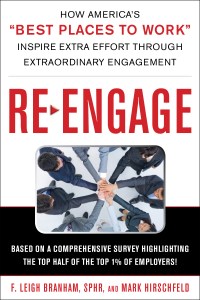
I’m pleased to announce that our book, Re-Engage, will be available February 12, 2010. My thanks to co-author and good friend Leigh Branham for making this one of the most exciting projects of my professional career!
Until then, I’ll be using this blog as a place to post the results of our continuing research into the elements of great workplaces.
You can also keep up with our musings on Twitter: @ReEngageBook

According to a study publishes by CNN some workplaces are definitely not good for your health! Thankfully, some are actually quite healthy. The study cites several factors that differentiate betweeen the two cohorts. The research for our book reaches similar conclusions. I’m convinced we can help our employees become healthier and more productive using these guidlines:
Not all workplaces are created equal when it comes to health. In fact, 38 percent of workers at certain jobs — called “effective” workplaces in the report — were much more likely to say they were in excellent health. Conversely, only 19 percent of employees in workplaces with a low effectiveness rating reported being in excellent health.
So what makes an effective workplace? Six factors make a difference, Galinsky says. Workers may feel healthier if they have “learning opportunities and challenge, a good fit between work and personal life, autonomy, having a supervisor who supports job success, economic security — no surprise in this economy — and a work climate of respect and trust,” she says.

A good post in the Montreal Gazette profiles two employers that have done an outstanding job creating a highly engaged place to work. Part of their strategy is helping employers through wellness. Here’s how one of the companies sees wellness and engagement:
Pfizer recently received the highest possible accreditation by Quebec’s Bureau de Normalization as a “healthy enterprise” for its Viva program.
Viva, says St-Pierre, is an employee wellness program based on prevention, awareness and employee support.
“It promotes healthy lifestyle habits through a three-pronged approach: physical activity, nutrition and work-life balance. Employees have access to coaching by health-care professionals, such as a kinesiologist or a dietitian and we have health fairs and workshops.”
In addition, there is an on-site gym, flexible work arrangements that feature Friday afternoons off and the Viva internal website that offers wellness information.
Congratulations to yet another employer who sees the value of wellness in helping employees achieve a healthier lifestyle and, in doing so, create a more productive, engaging place to work.
Cute video scenes on good and bad ways to retain employees. The “bad” are supposed to be spoofs, but sadly they are more real than we would like to admit.

From Talent Management, a study that reports high potential employees may still change jobs in spite of the recession:
High-potential employees aren’t afraid to strike out for greater opportunities despite the continuing recession, according to a study of how the best and brightest of high-potential talent have weathered the global recession over the past 18 months. The report released by Catalyst, “Opportunity or Setback? High Potential Women and Men During Economic Crisis,” offers an overview of the current workplace and recommends that even during international economic instability, employee retention must remain a foremost concern for businesses.
The article continues:
Overall, this study demonstrated that high potential women and men are successfully working through the recession with continued choices in employment and prospects for growth. Talent managers who view the economy as an opportunity to scale down on retention efforts should seriously reconsider in light of these surprising findings.
Our research confirms this point. We see many talented employees who are “sullen and near mutinous”, who are not being led in a way that gives them confidence in their current employer. Many are willing to take the calculated risk to find a place where they can grow and be recognized for contributing to a business that won’t ignore them.
A fews years from now we will fondly remember some businesses who hit the scrap heap and say “too bad they couldn’t hang on to their best and brightest– it might have made a difference.

Excellent advice from India’s Express Computer Online if you going through a downsizing.
If your organization has undergone trauma in the form of layoffs as a result of economic conditions or other reasons (e.g. M&A-induced redundancies), what should HR practitioners and organizational managers and leaders do? The WorkTrends results suggest a number of important steps that can be taken to enhance future levels of engagement and mitigate the potential of regrettable turnover.
- Confidence is key—Perhaps one of the most important first steps in any post-layoff environment is to regain employees’ confidence in the organization and particularly the future role that they play. While this may seem obvious, a crisis situation may cloud that. Confidence can be instilled in a variety of ways, but organizational leaders should communicate the strategy going forward, translate the strategy into what it means for workgroups, listen to employee concerns, and make clear how the future will be bright for individual employees. Give them a ‘light at the end of the tunnel.’
- Recognition and opportunity—In the midst of crisis, individuals still make their way the best they can. Life goes on, despite the turmoil. Managers need to consider this while the organization struggles; employees need to know that they are doing their job well and that there will be again opportunities from them at the organization, especially in times after crisis. In other words, give them a reason to hang in there.
- Turn ‘me’ into ‘we’—In a post layoff environment, employees may turn inward and worry more about matters that are personally relevant or give them a sense of security. Naturally, in times of uncertainty, employees and managers will be more concerned with their own work and livelihood. This tendency towards protectionism can threaten to break down the social ties that bind an organization together. Reinforcing messages such as ‘We are all in this together,’ and reiterating that group is stronger than individuals will encourage employees to bond together and increase organizational loyalty.
- Prepare for the rebound—Finally, while there are things that can and should be done now for your layoff survivors, it is also important to take a long-term perspective. The economy will eventually rebound, customers will return, and hopefully your company will return to its upward path to prosperity. How your layoff survivors are treated will become part of the organization’s history. If it is done well, that can help attract and retain new employees. If it is done poorly, it will have the opposite effect.
I recently assisted an organization that had to go through a downsizing. The leaders acted in a professional and dignfied manner. The reduction certainly had an impact– they always do– but that impact can be managed by effective leadership.
 Mark Hirschfeld